
Does catnip calm cats down? What it does, what it doesn't, and when to use it
Quick answer
Not directly. Catnip isn't a sedative and it won't calm a cat that's frightened right now; a scared cat usually ignores it. What it does do is end in a nap: ten minutes of play, then most cats wash and sleep. Cats that eat it rather than sniff it tend to skip the play and go straight to mellow. And a mist on a carrier or a new bed the day before makes it a place the cat has already chosen to sit in.
This question comes in two versions, from two different owners. One has a cat climbing the curtains at eleven at night and wants it to stop. The other has a cat under the bed since the move, or a vet appointment on Thursday and a carrier the cat has never willingly entered.
Catnip helps with one of those more than people expect and with the other less, and the difference matters, so here's the honest version.
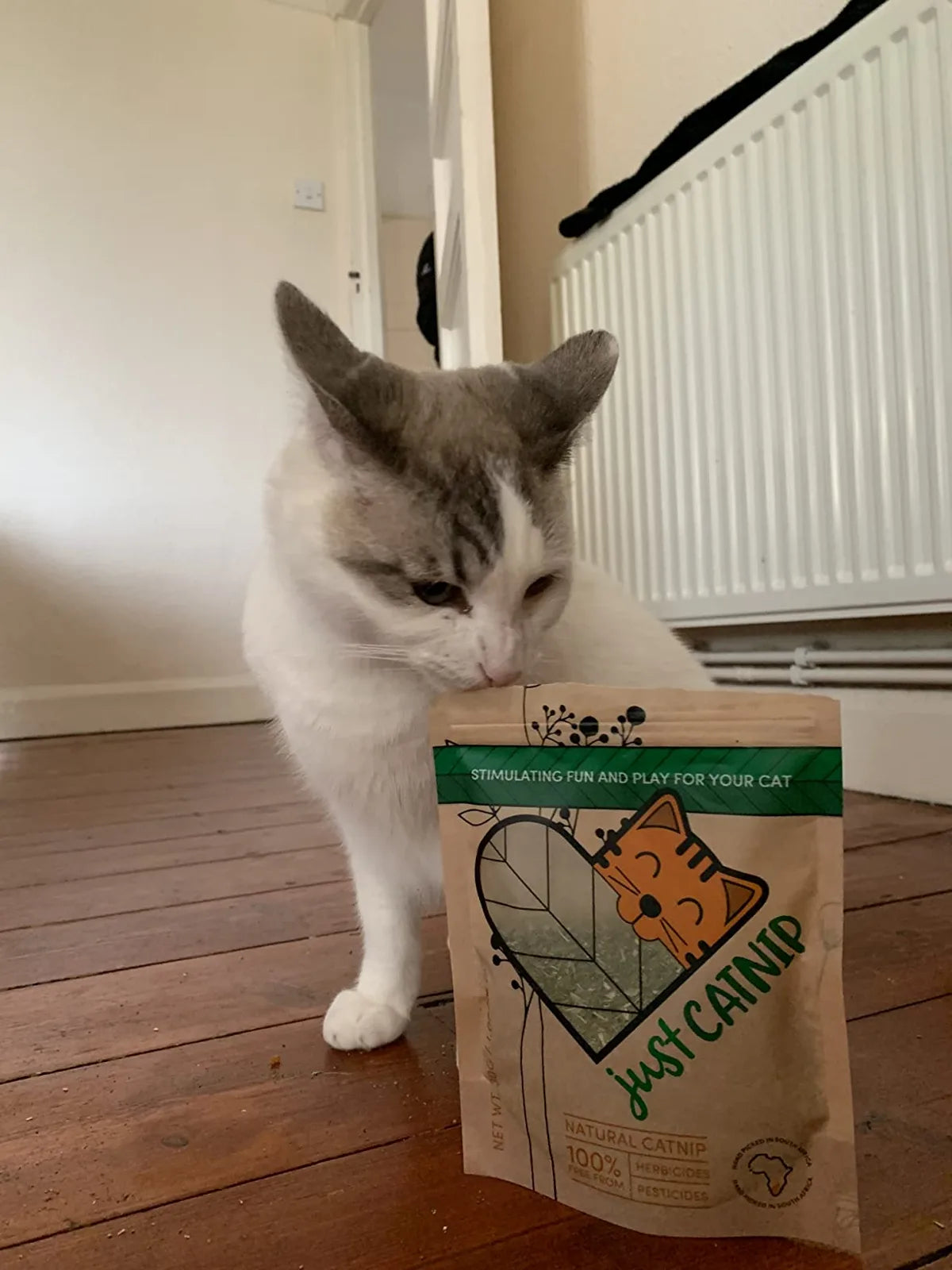
First, what catnip isn't
It isn't a sedative. Nothing is swallowed to get the effect, nothing slows the cat down, and there's no calming compound at work. Catnip is a smell. When a cat that responds to it sniffs it, the scent triggers a release of the cat's own feel-good chemicals, and the result is about ten minutes of rolling, rubbing and chasing nothing. That's the opposite of calm, for ten minutes.
And a frightened cat usually won't respond at all. A cat hiding under the bed on moving day, or hunched in the carrier with the engine running, isn't going to sniff a leaf and relax. Fear switches off play, and catnip is play. We've covered the whole reaction in What does catnip do to cats? and the question of what the reaction actually is in Does catnip get cats high?.
So if you're hoping for something to make a scared cat calm right now, catnip isn't it, and we'd rather tell you that than sell you a pouch.
What it does do
Three things, and they're worth having.
The nap afterwards. Most sessions end the same way: the cat stops, washes, finds a spot and sleeps, as it would after a good play. That's not a crash; it's a cat that's used some energy and is content. For the curtain-climber, a session at nine in the evening often means a cat asleep by half past.
Eaten catnip goes straight to mellow. Cats take catnip two ways. Sniffed, it's the lively reaction. Eaten (a chew and a swallow rather than a roll), a lot of cats skip the lively part and go straight to a slow wash and a stretch. Owners who only ever see their cat chew and doze think catnip "calms" theirs, and in that sense it does. We've written about eating in Can cats eat catnip?
A place becomes chosen. This is the one that solves the carrier. A cat that has rolled in a bed, a carrier or a blanket with catnip on it has had a good time there, and comes back to it. Not because it's calmer, but because it's a place it picked. Used ahead of time, that's the whole trick.
When it helps
The carrier, the day before. Leave the carrier out with the door open. A mist of spray or a pinch of crushed leaf inside, then walk away. The cat investigates, rolls, maybe sleeps in it. On the day, nothing more: a cat mid-reaction is harder to get through a door, not easier. What you want is a cat that's been in the carrier of its own accord within the last day.
A new home. A nervous cat in a new house may ignore everything, catnip included, for a week or two. Don't push it. When it starts to explore, a pinch on its own bed and blanket, the things that came with it, gives it a reason to settle on them rather than under the furniture. Then the new scratching post, so it chooses that over the sofa.
After visitors, a new pet, a change. The cat that's been put out by a houseful or a new kitten gets a ten-minute session that's just for it, on its own things, and then a sleep. It doesn't fix the kitten, but it's a good evening.
The bed they won't sleep on. A mist on the new bed, and it's been rolled in; that's usually all it takes.
The spray is what makes most of this easy, because you can't sprinkle leaf into a carrier and expect it to stay there. Two ingredients, distilled water and catnip hydrosol, so nothing marks fabric and there's nothing to eat. It's for everything you can't sprinkle.
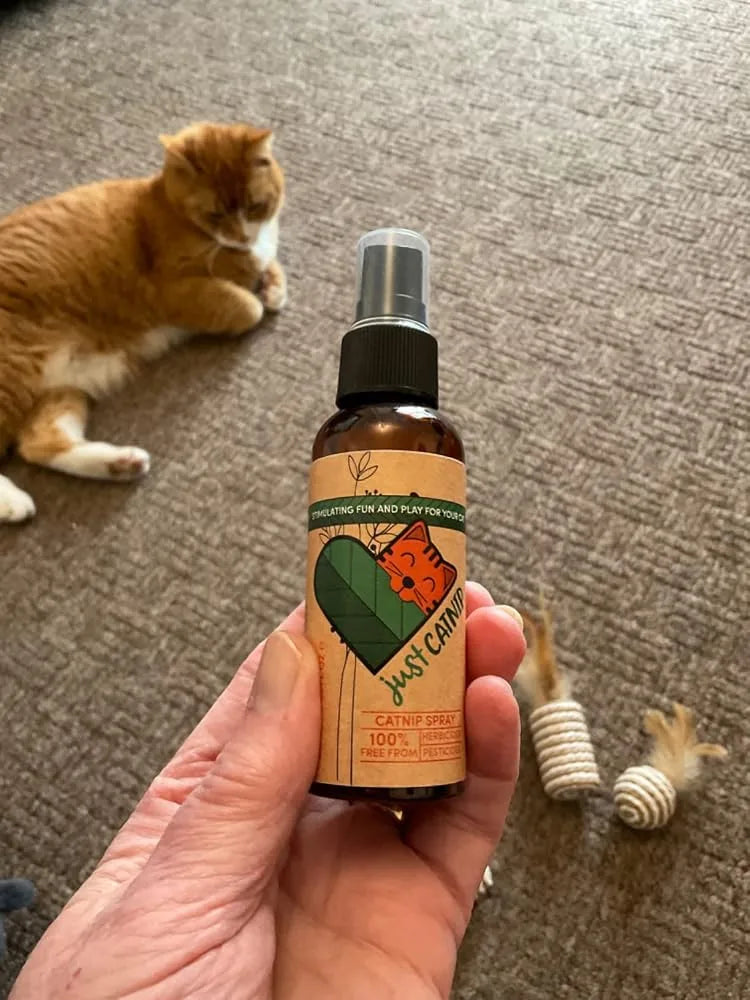
When it won't help
Fireworks night, thunderstorms, the vacuum cleaner. A frightened cat won't respond, and a cat halfway through a reaction when the first bang goes is a worse combination than either alone. Dark room, familiar bed, a hiding place, and leave it.
A cat that's stressed all the time. Hiding most of the day, not eating properly, over-grooming, spraying indoors. Catnip isn't a treatment for anything and we won't pretend it is. That's a vet conversation, and the sooner the better.
The boisterous ones. A few cats get wound up rather than playful on catnip: a swipe, a nip, a wild look. If yours is one, it's not the cat to use catnip on for calm. Give it the catnip when you want it to run about, and then give it the room.
Kittens. Most don't respond until about eight months, so there's nothing to calm them with. Play is what settles a kitten.
Cats that don't respond. Not every cat responds, and that's genetic; a lot of cats don't. For those, silvervine often does the same job; we've written about it in Silvervine for cats.
If your cat is unwell, pregnant or on medication, ask your vet before introducing anything new, catnip included.
What to try alongside it
For a cat that's unsettled rather than frightened, the things that work are mostly free: a routine that doesn't change, a high place to sit, a hiding place it's allowed to use, and play that ends in a catch. Pheromone diffusers (Feliway is the one most people know) are a different approach from catnip and can be used alongside it. For anything beyond that, your vet.
How to use it for calm
- Sniffed or eaten? If you want the lively session and the nap, crush a pinch and let the cat at it. If you want mellow from the start, offer a small pinch it can chew rather than a spread it can roll in; some cats will choose eating, some won't, and you can't force it.
- Timing. A session an hour before you want a quiet house, not during the thing you want it quiet for.
- The day before, not the day of, for carriers and beds.
- A pinch, not a heap. More doesn't make a bigger reaction; fresher does. We've written about frequency in How often can you give a cat catnip?
Ours is leaf and flower from a family farm in South Africa, picked by hand and air-dried. The spray is the same leaf as a water, 60ml, £12.99. The Duo is pouch and spray together, £19.99 as a one-off, which covers both the roll and the carrier. Every catnip order carries our money-back cat guarantee: if your cat doesn't respond, tell us within 14 days of delivery and we'll refund, nothing to send back.
Related guides: What does catnip do to cats? · How to use catnip · Can cats eat catnip? · Is catnip bad for cats? · Does catnip get cats high? · Silvervine for cats · How often can you give a cat catnip? · The Catnip Guide
Questions cat owners ask
Does catnip calm cats down?
Not in the moment; it isn't a sedative, and a frightened cat usually ignores it. But most sessions end in a sleep, and cats that eat it rather than sniff it often go straight to mellow. Used ahead of time on a carrier or bed, it makes the place familiar before the cat needs it.
Does catnip make cats sleepy?
Often, afterwards. The reaction itself is lively, about ten minutes of rolling and play, and then a lot of cats wash and sleep. That's the calm part people notice.
Can I use catnip to get my cat into the carrier?
Yes, ahead of time. A mist of spray or a pinch of leaf in the carrier the day before, with the door open, gives the cat a reason to go in and sit. On the day, don't add more; a cat mid-reaction is harder to handle, not easier.
Will catnip help a stressed or anxious cat?
Not as a treatment, and we'd never claim it. A stressed cat often won't respond at all. For a cat that's unsettled by a change (a new home, visitors, a new pet), catnip on its familiar things can help it settle into them. For stress that lasts, talk to your vet.
Does catnip make cats hyper?
For about ten minutes, yes, that's the reaction. A few cats get very wound up and want to be left alone for a bit. Then it stops. If yours is one of the boisterous ones, give it the catnip and then give it the room.
Is catnip a sedative?
No. Nothing is swallowed to get the effect, and it doesn't slow the cat down; it's a smell that triggers play, followed by a rest. The rest is ordinary tiredness, not sedation.


