
What does catnip do?
The sniff, the roll, the zoomies, the nap. What’s happening and why it only lasts ten minutes.
Guide
What catnip is, what it does to cats, who it works on and how to use it. Written by the people who grow it.
The sniff, the roll, the zoomies, the nap. What’s happening and why it only lasts ten minutes.
Short answer: yes, for healthy adult cats. The longer answer covers kittens, how much and how often.
Sprinkle, spray or both. How much, where to put it, and how to keep it fresh.
Browse the guide
Why a leaf makes a cat lose its dignity. The science, the genetics, and why a lot of cats don’t react at all.
Can cats eat it, how often, and at what age. Plain answers, and when to ask your vet.
Sprinkle, spray or both. How much to use, where to put it, and how to keep a pouch fresh.
Bored cats, indoor cats and cats that have stopped playing. What helps, with or without catnip.
Presents cats actually use, for Christmas, birthdays and no reason at all. Honest about what they ignore.
For the cats catnip doesn’t reach. Silvervine, valerian and how they compare.
Play & enrichment
Silvervine & alternatives
Using catnip
How catnip works
Using catnip
Quick answer
Catnip is a herb in the mint family. Its leaves and flowers carry an oil that most cats react to by sniffing, rolling, rubbing and playing, for about ten minutes at a time. It’s safe for healthy adult cats, it isn’t addictive, and a pinch is all you need. Some cats don’t react at all, and that’s genetic.

Catnip is Nepeta cataria, a leafy plant in the mint family with heart-shaped leaves and small white flowers. It grows easily in most climates, which is why it's been a garden plant for centuries and a cat toy for nearly as long.
The part that matters is an oil in the leaves and flowers called nepetalactone. When a cat sniffs it, the scent reaches receptors in the nose and sets off a short burst of behaviour that looks a lot like play and a little like courtship: sniffing, licking, chin and cheek rubbing, rolling, kicking, chasing nothing. It peaks fast and fades in about ten minutes, after which most cats lose interest for an hour or two, and often sleep.
It's the smell that does it. Eating catnip is harmless but mostly just makes a cat sleepy; the reaction comes from sniffing. That's why fresh catnip, with more of its oil intact, gets a bigger response than catnip that's been sitting on a shelf.
Not every cat reacts. The response is inherited, and a lot of cats simply don't have it. They'll sniff the catnip, maybe eat a bit, and walk away. It isn't a sign of anything wrong, and there's nothing you can do to switch it on. Kittens usually don't respond until they're a few months old; by about eight months you'll know which kind of cat you have.
Full articles in this section: What does catnip do to cats? · Why do cats like catnip? · Does catnip get cats high? · Why doesn't my cat like catnip?
For a healthy adult cat, catnip is safe. It isn't addictive, cats don't build up a tolerance in the way the word suggests, and they stop when they've had enough. A cat that eats a lot of it might be sick or have a loose stomach for a day, which is the same as any cat that eats a lot of any plant.
A few sensible limits:
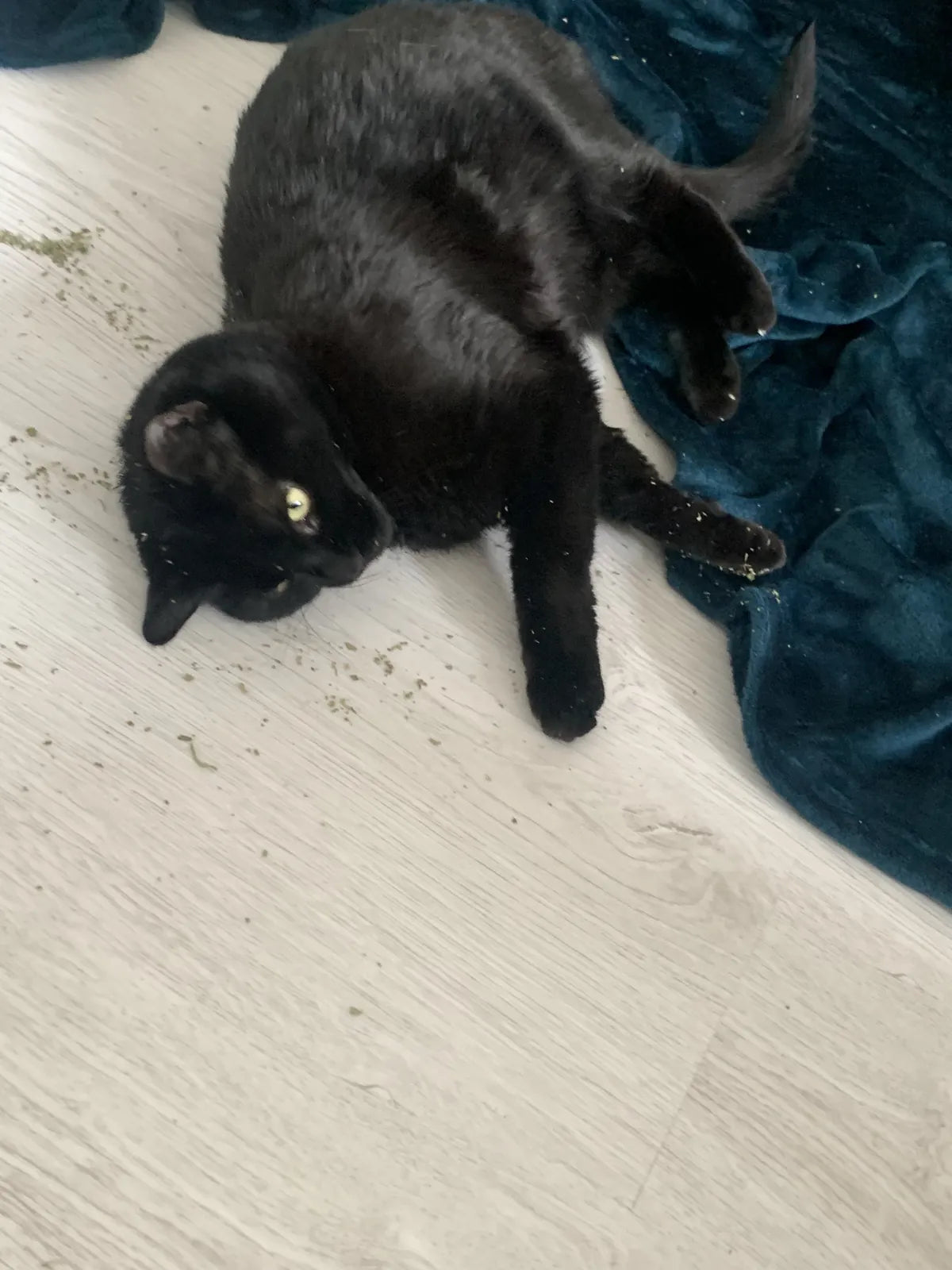
Full articles in this section: Is catnip good or bad for cats? · Can cats eat catnip? · Can kittens have catnip? · How often can you give a cat catnip?
There are two forms and they do different jobs.
Loose catnip (the pouch) is for sprinkling. Crush a pinch between your fingers to release the oil, then sprinkle it on a toy, a scratching post, a bed, or inside a cardboard box. Rub it into a kicker toy for the biggest reaction. Sweep up what's left after the session, or leave it; it's a leaf.
Catnip spray is for things you can't sprinkle: a new scratching post the cat is ignoring, a carrier before a vet trip, a new bed, a toy that's gone stale. A couple of mists is enough. It doesn't mark or stain, and there are no crumbs.
Used together, the spray gets a cat interested in a thing and the loose leaf gives them something to do with it.
Keeping it fresh. Catnip loses its scent over months, faster if it's open, warm or in the light. Keep the pouch sealed in a cupboard. If your cat has gone off a pouch that used to work, it's probably the pouch, not the cat. Buying small amounts more often beats a big jar that goes flat.
Full articles in this section: How to use catnip · How much catnip should you give a cat? · How to use catnip spray · How long does catnip last? · Does catnip go off?
Catnip is a short burst of fun. It's not a substitute for play, and the cats who get the most out of it are the ones who already have something to do.
An indoor cat needs, at minimum: something to scratch, something to climb or sit on up high, something to chase that they can actually catch, and ten minutes a day of a human on the other end of a wand toy. Add a cardboard box every so often and you've covered most of what a bored cat is bored about.
Catnip fits around that. A pinch in the box, a mist on the post, a rub on the kicker toy. It makes the things you already have interesting again.
Full articles in this section: Best catnip toys for indoor cats · Is my cat bored? · Cat enrichment ideas · How to play with a cat · Signs your cat is happy
Cats are honest about presents. The ones that get used are consumable or interactive: fresh catnip, a scratch board, a toy they can catch, a box. The ones that don't are costumes, anything with glued-on parts, and most things that need an Allen key.
We've written two guides: Christmas gifts for cats and gifts for cats by budget. Both are honest about what cats ignore, and both cover what to do if the cat turns out to be one that doesn't respond to catnip.
For the cats catnip doesn't reach, there's silvervine: the dried fruit, powder or sticks of a climbing plant from Japan and China. It triggers the same rolling, rubbing response through a related set of compounds, and most cats that ignore catnip react to it. Valerian root and honeysuckle wood work on some cats too.
Our advice is to try catnip first. It's cheaper, most cats love it, and if yours doesn't, our money-back cat guarantee means you're not out of pocket: tell us within 14 days of delivery and there's nothing to send back. Then try silvervine.
Full articles in this section: Silvervine for cats · Silvervine vs catnip · Catnip alternatives
A herb in the mint family. Its leaves and flowers carry an oil that most cats react to by sniffing, rubbing, rolling and playing, for about ten minutes at a time.
Yes, for healthy adult cats. It isn’t addictive and cats stop when they’ve had enough. Wait until kittens are about eight months old.
The response is genetic, and a lot of cats don’t have it. It’s not something you can change. Silvervine works on most of the cats catnip doesn’t.
A pinch. Crush a few leaves between your fingers and sprinkle on a toy, scratching post or bed. More doesn’t make it stronger.
It loses its scent over months, faster if it’s left open or in the light. Keep it sealed, cool and dark, and buy small amounts often.
Try catnip first; it’s cheaper and most cats love it. If yours shrugs, silvervine is the next thing to try.
Same catnip, four ways. Grown on a family farm, picked by hand, air-dried and packed leaf and flower only.
30g resealable pouch
£9.99 one-off
Subscribe & Save £4.99 first order, then £7.49 every 8 weeks
Choose your plan — Catnip30g pouch + 60ml spray
£19.99 one-off
Starter Kit £12.99 first order, then £7.49 every 8 weeks
See the Starter Kit — The DuoNew guides, the odd offer and the occasional cat. No more than twice a month.

Who’s behind this
Just Catnip is a small company that sells one thing. Our catnip is grown on a family farm at Bushwillow Estate in South Africa, hand-picked, air-dried and packed by hand. Over 100,000 customers have bought it, and we read every review, which is where most of what’s in this guide comes from. Where a question needs a vet’s answer, we say so.
Meet the farm


