
Is catnip bad for cats? The good, the bad and the bits to watch
Quick answer
No. Catnip is safe for healthy adult cats: it isn't toxic, it isn't a drug and it isn't addictive, and cats stop on their own after about ten minutes. The things to watch are small: a cat that eats a lot may get an upset stomach, a few cats get boisterous and want space, and concentrated catnip oil is not the same thing as the plant. If your cat is pregnant, on medication or unwell, ask your vet first.
Most people ask this question with a pouch already in their hand. Someone gave them catnip, or they bought it on a whim, and now the cat is looking at them and they want to be sure. So here's the whole answer, including the parts the "yes it's fine" articles leave out.
We grow and sell the plant, which is a reason to be careful about what we claim for it, not a reason to oversell it.
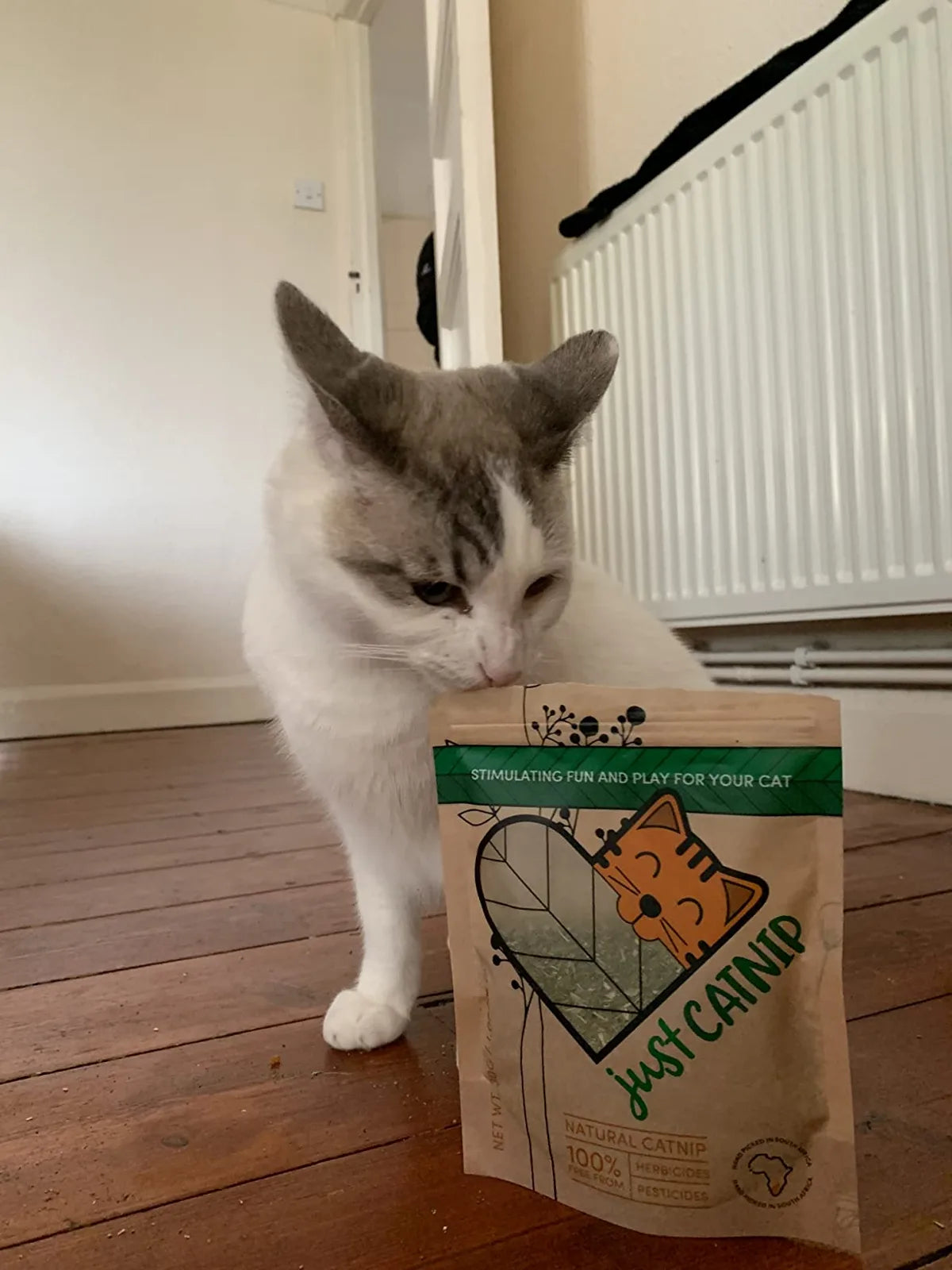
The short answer
Catnip is a herb in the mint family, and it's on Cats Protection's list of plants that are safe for cats. The reaction is caused by a scent in the leaves, nepetalactone, which cats pick up through the nose. Nothing has to be swallowed, nothing enters the bloodstream the way a drug would, and the cat's own brain does the rest. A cat on catnip is a cat enjoying a smell, very much.
That's why the safety picture is so simple. There's no dose to get wrong, because sniffing switches itself off: after about ten minutes the cat loses interest and won't react again for a while, however much catnip is around. We've described the reaction itself in What does catnip do to cats? and the science in Why do cats like catnip?
One thing you may come across: the ASPCA's plant list files catnip under 'toxic to cats'. Read the entry and the reason is that eating a lot of it can cause vomiting and diarrhoea, which is the stomach point below, not a poisoning. Cats Protection lists it as safe, and we'd rather you had both views than one.
What catnip is good for
The benefits of catnip are practical ones. For the cats that respond, it's one of the few things that reliably gets a cat to do something.
- Ten minutes of real exercise. Rolling, kicking, chasing nothing. For an indoor cat that's a proper session, and it costs you a pinch.
- Using the things you bought. A pinch on the new scratching post, the new bed or the cat tree, and the cat has a reason to try it. Most "my cat ignores it" problems are solved this way.
- The carrier. A mist of spray in the carrier the day before the vet makes it a place the cat has chosen to sit in before. It doesn't make the trip fun, but it takes the fight out of the first part.
- A dull afternoon. Something to do that isn't the sofa.
- Toys that have gone quiet. A crushed pinch rubbed into a kicker toy brings it back.
It has no calories, so it's the one treat you don't have to count, and nothing is eaten to get the effect. We've written the practical version of all this in How to use catnip.
What can go wrong, honestly
Everything on this list is small, and most owners never see any of it. But it's the list.
Eating a lot of it. The reaction is a smell, but cats lick and chew the leaves too, and a little eaten is fine. A lot, which happens when a pile is left on the floor or a pouch is left open, can mean a sick cat or a loose stomach for a day, the same as eating a lot of grass. Then it passes. A pinch at a time, and the pouch sealed, is the whole precaution. We've gone into this properly in Can cats eat catnip?.
The boisterous ones. A few cats get over-excited rather than playful: a swipe, a nip, a wild look. It's the same reaction turned up, and it stops when the catnip does. If yours is one, give it the catnip and then give it the room. Don't put your hands in the middle of it.
Toys, not catnip. Most "catnip" accidents are toy accidents: glued-on eyes, bells, ribbon and loose stuffing that come off and get swallowed. The catnip isn't the problem; the toy is. Choose toys with stitched features and nothing to pull off.
Concentrated oils. Catnip essential oil is not the plant. It's a concentrated extract, and PDSA's advice on essential oils is never to put them on a cat and to keep cats away from diffusers; we'd treat catnip oil the same way. A catnip spray should be water-based: ours is two ingredients, distilled water and catnip hydrosol, with no oil in it. If a spray lists oils, alcohol or "fragrance", it isn't the same thing.
Daily use dulls it. This isn't harm, but it's worth knowing. Catnip every day is safe and the cat won't suffer, but the reaction gets smaller. Kept as a treat, it stays a treat. The details are in How often can you give a cat catnip?

Is it a drug? Is it addictive?
No, on both counts, though the question is a fair one given what the reaction looks like.
In 2021 a research team in Japan showed that the scent raises the level of beta-endorphin, the body's own feel-good chemical, and that blocking it stopped the rolling and rubbing. So the pleasure is real, but it's the cat's own chemistry doing it, in response to a smell. Nothing is consumed, nothing builds up, and there's no tolerance to climb. Cats don't seek it out between sessions and don't miss it when it stops. We've written about the "high" question in Does catnip get cats high?; the short version is that a cat on catnip is closer to a dog with a tennis ball than to anything else.
Does catnip make cats sleepy?
Often, afterwards. The session itself is lively. When it ends, a lot of cats wash, find a spot and sleep, as they would after any good play. Cats that eat catnip rather than sniff it tend to skip the lively part and go straight to mellow, which is why an owner who only ever sees the cat chew and doze may think catnip "calms" their cat. It does, in that sense. It isn't a sedative.
Which cats should sit it out
- Pregnant cats, cats on medication, cats recovering from surgery or with a health condition. Ask your vet before introducing anything new, catnip included. We'd rather say that than guess.
- Kittens. Safe, but pointless. The response is inherited and switches on as the cat matures, usually at about eight months, so a kitten sniffs it and walks off. We've written Can kittens have catnip? for the details.
- Cats that don't respond. Not every cat responds, and that's genetic; a lot of cats don't. It isn't a sign of anything. For those cats, silvervine usually works, and we've covered it in Silvervine for cats.
How to use it safely
This is the whole method.
- Crush a pinch between your fingers to release the oil. More doesn't make a bigger reaction; crushed does.
- Put it on a toy, a scratching post or the floor, and step back.
- Let the cat finish. It will, in about ten minutes.
- Seal the pouch and put it away from light. Fresh catnip is strong catnip, and a pinch of fresh does more than a heap of stale.
If you bought catnip from us and your cat turns out to be one of the unmoved, our money-back cat guarantee covers it: tell us within 14 days of delivery and we'll refund, nothing to send back.
Choosing a catnip that's just catnip
The safest catnip is the simplest. Look for one ingredient: dried catnip, leaf and flower. No fillers, no added scent, no "blend". Ours is grown on a family farm in South Africa, picked by hand, air-dried and packed as leaf and flower, with nothing else in the bag. The 30g pouch is £9.99 as a one-off, or £4.99 for the first pouch on Subscribe & Save and £7.49 every eight weeks after that.
For the things you can't sprinkle, the spray is the same leaf as a water: two ingredients, nothing to eat, nothing to mark fabric. The Duo is both together, £19.99 as a one-off.
Related guides: What does catnip do to cats? · Why do cats like catnip? · How often can you give a cat catnip? · How to use catnip · Can cats eat catnip? · Can kittens have catnip? · Silvervine for cats · The Catnip Guide
Questions cat owners ask
Is catnip bad for cats?
No. Catnip isn't toxic, isn't a drug and isn't addictive. Cats control the dose themselves: they walk away after about ten minutes and won't react again for a while. The only common problem is a cat eating a large amount, which can mean an upset stomach for a day.
Is catnip good for cats?
For the cats that respond, yes: ten minutes of play and exercise, a way to get them using a new scratching post or bed, and something to do on a wet afternoon indoors. It has no calories and nothing is swallowed to get the effect.
Can catnip hurt a cat?
Not in ordinary use. A cat that eats a lot can be sick or have a loose stomach for a day, and a few cats get over-excited and want to be left alone for a few minutes. Concentrated catnip essential oil is a different product from the plant and shouldn't be used on or around cats.
Is catnip addictive?
No. Cats don't look for it between sessions and don't miss it if it stops. Daily use isn't harmful, but it can dull the reaction, so most owners keep it as a treat.
Does catnip make cats sleepy?
Often, afterwards. The reaction itself is lively; once it wears off, a lot of cats wash and sleep. Cats that eat catnip rather than sniff it tend to go straight to the mellow part.
Which cats shouldn't have catnip?
Ask your vet first if your cat is pregnant, on medication, recovering from surgery or has a health condition. Kittens can have it safely but usually don't react until about eight months, so there's nothing to gain.


