
Can kittens have catnip? What age it's safe, and when it starts to work
Quick answer
Yes, catnip is safe for kittens at any age; it isn't toxic and there's nothing in it a kitten can't handle. It just doesn't do anything yet. The rolling, rubbing reaction is inherited and switches on as a cat matures, usually at around eight months, some earlier and some later, so most kittens sniff it and walk off. Try a pinch at about eight months; if nothing happens, try again a month later.
This gets asked two ways. The worried version: I've got a kitten and someone gave us catnip, is it safe? The disappointed version: I gave my kitten catnip and nothing happened, is something wrong?
The answer to both is the same, and it's good news. Safe, yes. Working, not yet. Here's why, when it changes, and what to do with a kitten in the meantime.

Photo by Azimbek Assarov on Unsplash
Is catnip safe for kittens?
Yes. Catnip is a herb in the mint family, it isn't toxic to cats of any age, and the reaction, when it comes, is caused by a smell rather than anything swallowed. A kitten that sniffs it, licks it or eats a bit of it is fine. We've written the adult version of the safety question in Is catnip bad for cats?, and everything in it applies to kittens too.
The one practical caution is eating. A small kitten is more likely to eat a loose pinch than to sniff it, and a kitten that eats a lot of any plant can end up with an upset stomach for a day. That isn't a reason to be frightened of catnip; it's a reason not to bother with it until the reaction is there, because until then eating is all the kitten will do with it.
Why kittens ignore it
The catnip response is inherited. A cat either has the trait or it doesn't, and in the cats that have it, it isn't present from birth. It switches on as the cat matures.
A geneticist working with a colony of cats reported in 1962 that the response doesn't show in kittens under six to eight weeks and may not be fully developed until about three months, so the age is a range, not a date. Owners tend to see it later than the textbooks say: some kittens react at five or six months, a lot don't until about eight, and a few take closer to a year. Until then catnip is just a leaf. The kitten isn't broken, and the catnip isn't stale. It's early.
And a reminder that applies to all cats: not every cat responds, and that's genetic. A lot of cats never do, kitten or adult. If yours reaches a year and still shrugs, it's probably one of them, and silvervine usually works instead; we've written about it in Silvervine for cats.
When to try, and how
Around eight months is a sensible first go. Here's how to give it a fair chance.
- Crush a pinch between your fingers to release the oil. Uncrushed leaf gives off very little.
- Put it on the floor or on a toy somewhere quiet, and step back. Don't hold it out; a hand in the way turns it into a different game.
- Watch for the signs. A long sniff, then a cheek rub, then a roll. If you get the roll, the response has arrived.
- If nothing happens, sweep it up and try again in a month. The first reaction often arrives between one try and the next.
A first reaction is a small event. Most owners remember it. We've described what the full reaction looks like in What does catnip do to cats?, and the science of why it happens in Why do cats like catnip?
What a kitten wants instead
A kitten doesn't need catnip to have a good time. A kitten needs things to stalk, catch, hold and kick, and it needs you to move them. The months before the catnip response arrives are the months when a kitten learns how to play, and the toys it learns on are the toys it keeps using.
- A wand toy. Let the toy hide, flick it, let the kitten stalk and catch. End with a catch they can hold.
- A kicker toy. Long enough to hug with the front legs and kick with the back. The toy that survives.
- A scratch board. Flat, corrugated card, from day one, so the sofa never gets a look-in.
- A box. Always a box.
One thing to check on any toy you buy: stitched features only. No glued-on eyes, no bells, no ribbon, nothing a kitten can pull off and swallow. That's the actual safety question with "catnip toys", and it's about the toy, not the catnip.
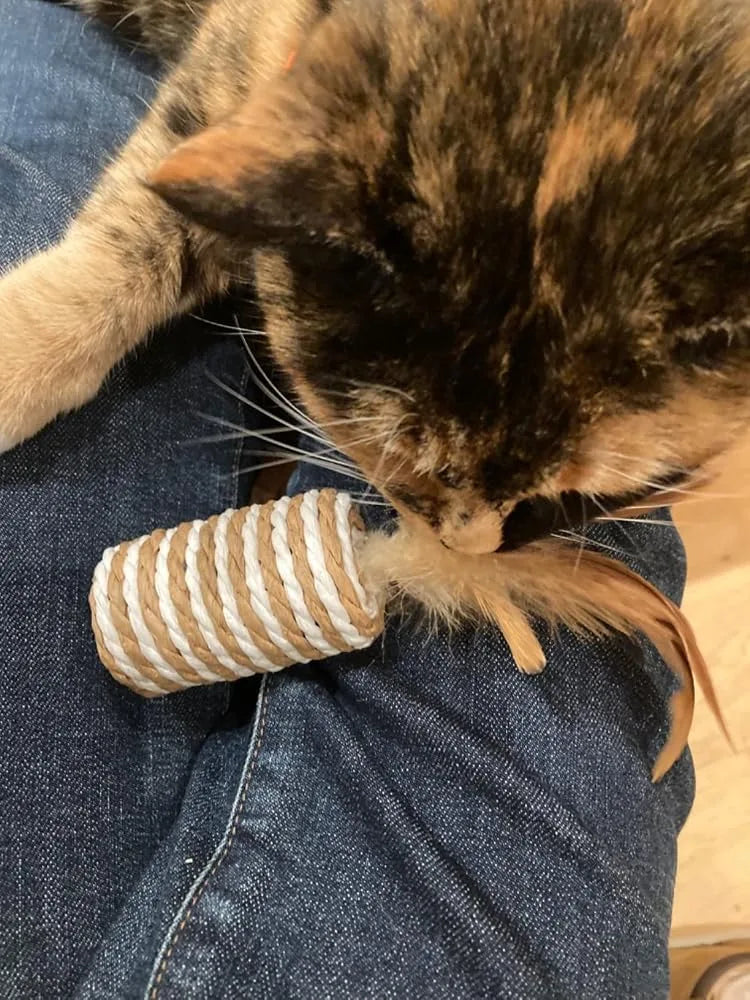
The Chew & Chase Play Set is built this way: three kicker toys, a mouse on a wand, a corrugated scratch board and a 60ml catnip spray, £21.99. None of the toys have catnip in them, so they work for a kitten from the first day, and they don't go stale in a drawer waiting for the day the response arrives. The spray is how you add the catnip later: two mists on a toy or the board when your cat is ready, and again whenever it fades.
Spray, and kittens
The spray is fine around kittens for the same reason the leaf is: it's two ingredients, distilled water and catnip hydrosol, and there's nothing loose to eat. It won't do anything for a kitten before the response arrives either, but it's useful in a kitten house for the things you can't sprinkle: a mist on the scratch board so it carries the scent from the start, or on a bed you'd like them to choose. Once the response is there, it's the same reaction as the leaf without anything to clear up.
Rescue cats and unknown ages
If you've adopted a cat whose age is a guess, try the pinch anyway. An adult that doesn't respond is either a non-responder or stressed: a cat in a new home may ignore everything, catnip included, for weeks, and then suddenly not. Give it time, try again, and if it's still a shrug after a few months, try silvervine.
The first-catnip kit
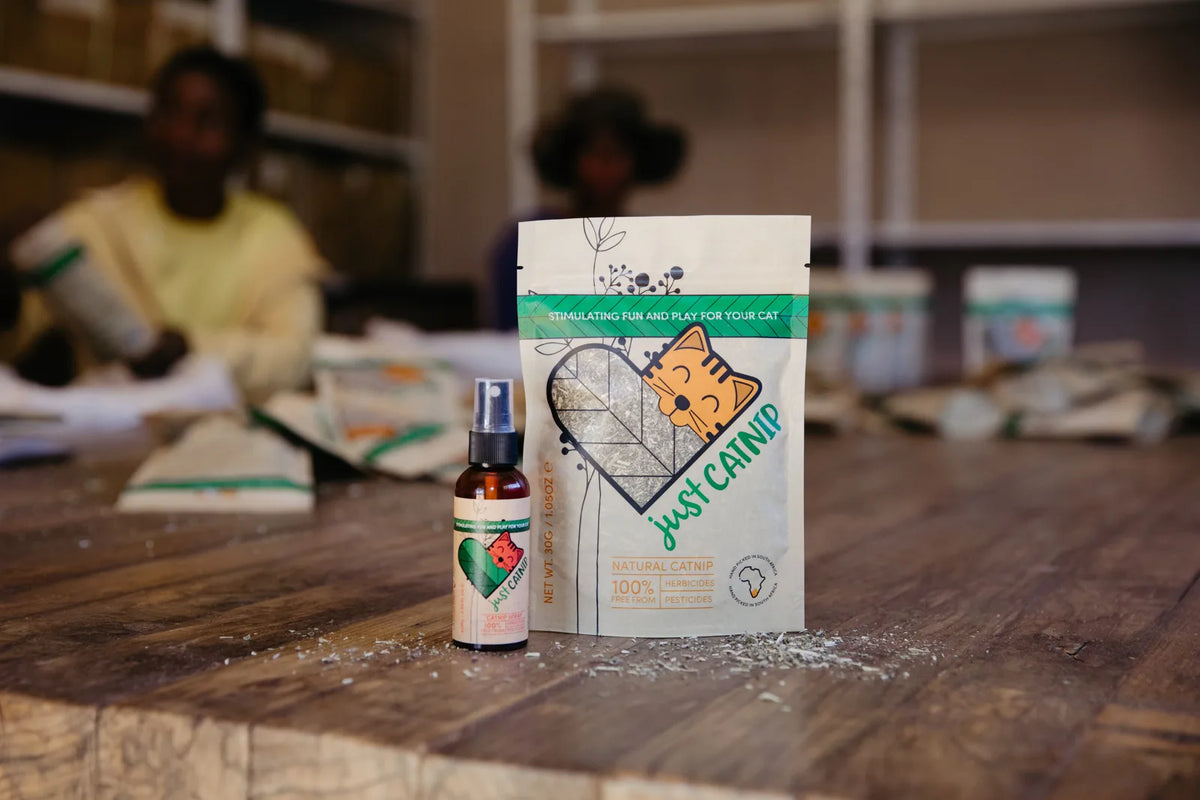
If you want to have it ready for the day, or you're buying for someone who has just got a kitten, the Duo is the pouch and the spray together, £19.99 as a one-off: the leaf for the first try, the spray for the things you can't sprinkle. Both fit through the letterbox. The pouch keeps for months sealed and out of light, which is long enough for most kittens to grow into it. One honest note: our guarantee runs for 14 days from delivery, so if you'd like it covered, try the pinch when the pouch arrives rather than waiting.
Catnip from us is one ingredient: dried catnip, leaf and flower, grown on a family farm in South Africa, picked by hand and air-dried the same season. And if the day comes and your cat turns out to be one of the unmoved, our money-back cat guarantee covers it: tell us within 14 days of delivery and we'll refund, nothing to send back.
Related guides: What does catnip do to cats? · Why do cats like catnip? · How to use catnip · Is catnip bad for cats? · Can cats eat catnip? · Silvervine for cats · Gifts for cats · The Catnip Guide
Questions cat owners ask
Can kittens have catnip?
Yes, safely, at any age. It isn't toxic. But most kittens don't react to it until about eight months, when the inherited response switches on, so before then there's nothing to gain.
What age can kittens have catnip?
Any age is safe. The age it starts to work is usually around eight months, some earlier and some later. Try a pinch then; if nothing happens, try again a month on.
Why doesn't my kitten like catnip?
Almost certainly because the response hasn't switched on yet. It's inherited and develops as the cat matures. Not every cat responds even as an adult; a lot of cats don't, and that's genetic too.
Are catnip toys safe for kittens?
The toy matters more than the catnip. Choose toys with stitched features and nothing to pull off: no glued eyes, bells or ribbon. Toys that have no catnip in them, with a mist of spray added later, work from day one and don't go stale.
Can kittens eat catnip?
It's safe, but a small kitten is more likely to eat a loose pinch than sniff it, and eating a lot can upset the stomach. That's the practical reason to wait until the reaction is there.
What should I give a kitten instead of catnip?
Play. A wand toy to stalk and catch, a kicker toy to hold and kick, a cardboard box, and ten minutes of your time twice a day. A kitten doesn't need catnip to have a good time; it needs you to move the toy.


