
Cat enrichment: 12 ideas for indoor cats that actually get used
Quick answer
Enrichment is giving an indoor cat the things it would find outside: something to hunt, somewhere to climb and hide, something to scratch, smells to investigate, food that takes effort, and a window to watch. The ideas below cover each, most cost nothing, and the ones that work best are the ones you do every day rather than buy once.
"Enrichment" is a word that makes a simple thing sound like a project. All it means is: what does a cat do outside that it can't do in your flat, and how do you give it that indoors? Hunt, climb, hide, scratch, sniff, work for food, watch.
Here are twelve ways, grouped by what the cat gets. Each has the five-minute version and the proper version, and we've been honest about which ones cats tend to drop. We sell catnip, so one of the twelve is ours; the other eleven you can do with what's in the house.
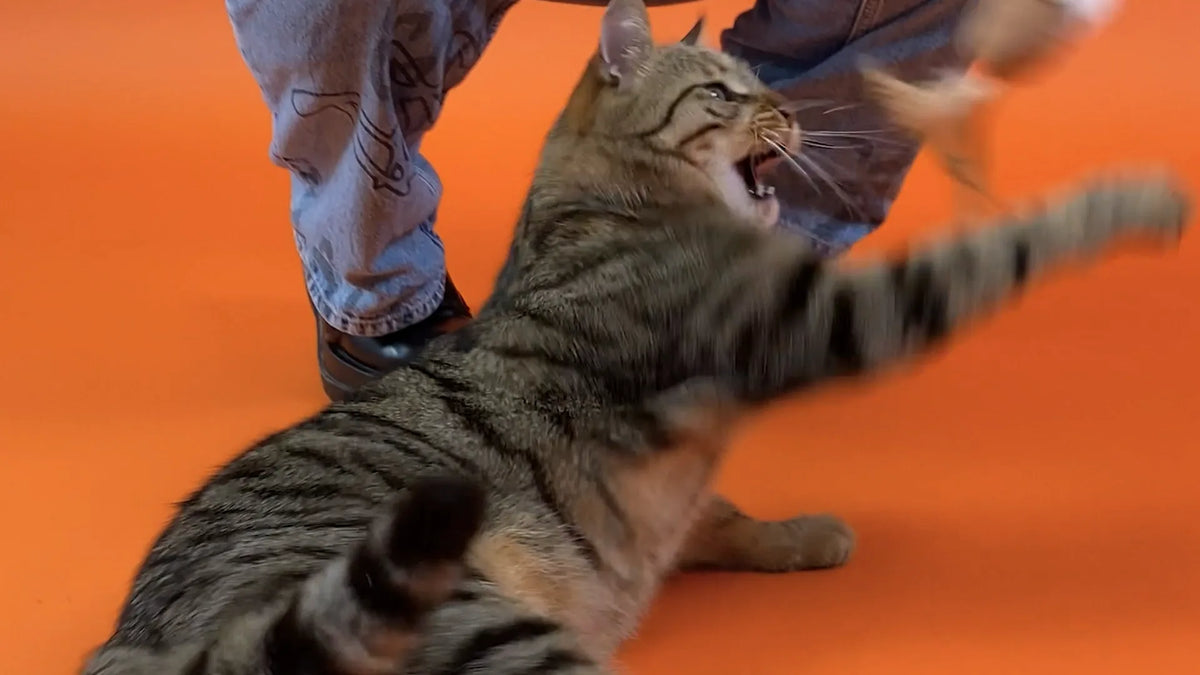
Hunt
1. The wand hunt, twice a day
The one that matters most. A wand toy with something on the end, moved like prey: hidden behind a cushion, darting across the floor, pausing, never flying at the cat's face. Let the cat stalk. Let it catch. End with the catch held and kicked, then, if it's near a mealtime, food. That's the sequence a cat is built for, and ten minutes morning and evening does more than everything else on this list combined.
Five-minute version: a feather on a string. Proper version: a wand with swappable ends, so the prey changes (Da Bird is the one most people name). What gets dropped: laser pointers, because there's never a catch, and a cat that can never catch the thing gets wound up rather than satisfied.
2. Kicker toys for solo play
A toy long enough to hug with the front legs and kick with the back, for the hours you're not there. Cats hold them, kick them, carry them about and sleep on them. Stitched features only, nothing to pull off.
Five-minute version: a rolled-up sock. Proper version: three kickers, one out at a time, swapped weekly. A pinch of crushed catnip rubbed in when it goes quiet brings it back.
3. Rotation
Not a toy, a rule. Three toys out, the rest in a drawer, swapped every week. A cat ignores what's always there and investigates what's new, and "new" can mean "the thing it hasn't seen since September". This is the cheapest idea on the list and the one most people skip.
Climb and hide
4. Somewhere high
Cats feel safe up. A cat tree by the window is the standard answer; a cleared shelf, the top of a bookcase with a route up, or a wall-mounted perch does the same. One high spot with a view changes how a cat uses the whole room.
Five-minute version: clear the top of a bookcase and put a folded blanket on it. Proper version: a tall tree that doesn't wobble, by the window.
5. A box with a hole in it
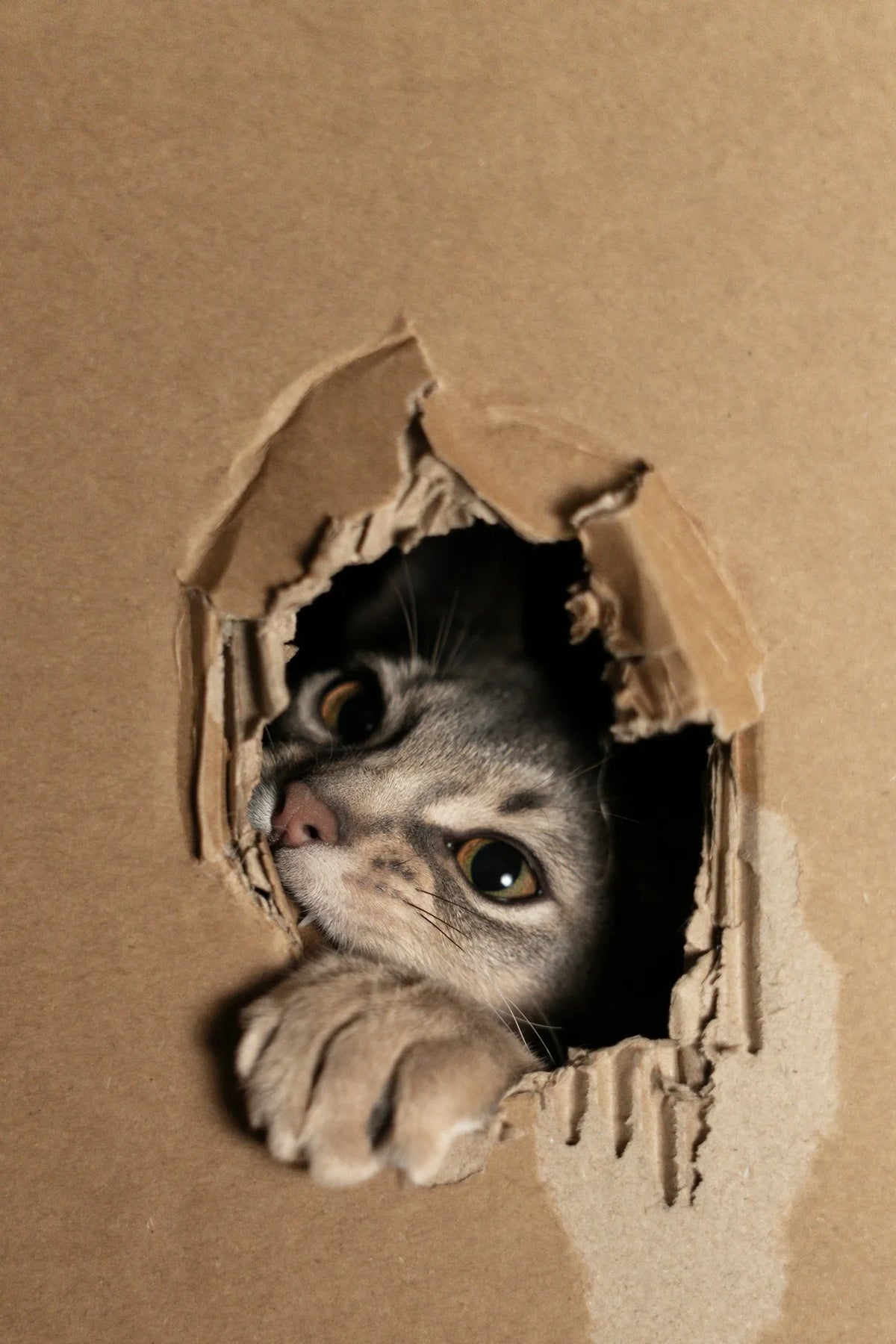
Every delivery box is enrichment. Cut a cat-sized hole in one side, leave it somewhere new, and it's a den, a hunting hide and a toy for a week. Then recycle it and do the next one. Cats never tire of boxes; they tire of the same box.
6. A tunnel
Better with two cats, still good with one. Something to run through, ambush from and sleep in. A folded tunnel lives in a cupboard between appearances.
Five-minute version: a paper bag with the handles cut off. Proper version: a crinkly tunnel with two ends and a hole in the middle.
Scratch
7. A post where the cat already scratches
Cats scratch where they wake up and where they greet you, which is why the sofa gets it. Put the post there, not in the hall. Tall enough to stretch up, stable enough not to tip, and the surface the cat already likes (sisal for the vertical scratchers, corrugated card for the ones that go flat). A pinch of catnip on a new post gets it tried.
Scratching is enrichment in itself: it's how a cat marks, stretches and sheds claw. A cat with nothing good to scratch isn't being naughty on the sofa; it's doing the only thing available.
Smell
8. Catnip and silvervine
Scent is most of how a cat reads the world, and most homes smell of nothing to a cat. Catnip is the obvious fix: for the cats that respond, a pinch crushed between the fingers onto a toy, a post or the floor gives ten minutes of rolling, kicking and chasing nothing, which is exercise and novelty in one, then usually a sleep. Keep it as a treat rather than a daily thing, so it stays interesting. We've written the full method in How to use catnip.
Not every cat responds, and that's genetic; a lot of cats don't. For those, silvervine usually does, and we've covered it in Silvervine for cats. Kittens mostly don't respond to either until about eight months.
Ours is leaf and flower from a family farm in South Africa, picked by hand and air-dried. The 30g pouch is £9.99 as a one-off, or £4.99 for the first pouch on Subscribe & Save and £7.49 every eight weeks after that. The spray is the same leaf as a water, for everything you can't sprinkle: a mist on the post, the tunnel or the bed.
9. Smells from outside
A handful of leaves, a bit of bark, a twig, brought in and left on the floor. A cat will spend ten minutes on a stick from the garden. Check it hasn't been sprayed with anything, then let the cat investigate and bin it after. Free, and a different smell every time.
Work for food
10. A puzzle feeder, or a mat
A cat outdoors eats several small catches a day; a cat indoors eats twice from a bowl in thirty seconds. Making the food take effort is the easiest way to give a cat a job. Puzzle feeders (balls that drop kibble as they roll, boards with pockets to fish from) are the proper version; Catit's Senses range and Trixie's activity boards are the common ones, and Doc & Phoebe's indoor hunting feeder is the prey-shaped version for cats that like to stalk their dinner. The free version is dry food scattered across a mat or a hard floor so it has to be found, or a toilet-roll tube with the ends folded in and a few biscuits inside.
Start easy. A cat that can't get the food out of a hard puzzle gives up, and then the puzzle is furniture.

Photo: Anja, CC BY-SA 4.0, via Wikimedia Commons
11. Hidden treats
Three or four treats hidden around a room while the cat watches you leave, then let in to find them. A hunt without a toy. Count them towards the day's food.
Watch
12. A window, with something in it
The cheapest cat entertainment there is. A windowsill wide enough to lie on, or a perch fixed under one, with a bird feeder outside. Cats will watch a feeder for hours, and chattering at it is the point. If there's no garden, a window onto a street with people on it is still a window.
What gets ignored
Honest list; this is the usual pattern:
- Electronic toys that move on their own. Exciting for a day, then a cat learns there's no catch and stops.
- Laser pointers. No catch, ever. Some cats get frustrated rather than tired.
- Twenty toys out at once. See rotation.
- A tree in the wrong place. A cat tree in a corner with no view gets used as a scratching post and nothing else. Move it to the window.
- A puzzle feeder that's too hard. The cat gives up and so do you.
Putting it together
If you do nothing else: the wand hunt twice a day, a box with a hole in it this week, three toys on rotation, a post by the sofa and a window with a feeder outside. That's five of the twelve, it costs almost nothing, and it covers hunt, hide, scratch and watch. Add catnip for the smell if your cat responds. We've written about how to set the home up in Keeping an indoor cat happy, and how to tell when a cat needs more in Is my cat bored?
The Chew & Chase Play Set covers ideas 1, 2 and 7 in one box: three kicker toys, a mouse on a wand, a corrugated scratch board and a 60ml catnip spray, £21.99. None of the toys contain catnip; the spray is how you add it, and add it again when it fades.
Related guides: Keeping an indoor cat happy · Is my cat bored? · How to use catnip · Silvervine for cats · Gifts for cats · Cat birthday ideas · The Catnip Guide
Questions cat owners ask
What is cat enrichment?
Anything that gives a cat the experiences it would get outdoors: hunting, climbing, hiding, scratching, exploring smells, working for food and watching the world. For an indoor cat, it's the difference between a home that happens to contain a cat and one built for it.
What are the best enrichment toys for cats?
A wand toy you move (the hunt), kicker toys the cat can hold and kick on its own, a scratch board or post, a puzzle feeder, and a cardboard box. Rotated, not all out at once. Expensive electronic toys tend to be ignored after a week.
How do I enrich my cat's life while I'm at work?
A window perch with something to watch, food hidden or in a puzzle feeder, a box or tunnel that's new this week, a scratch board, and a proper play session before you leave and when you get back. Cats sleep most of the day anyway; the hunts are what matter.
Is catnip enrichment?
Yes, for the cats that respond: it's scent enrichment and ten minutes of exercise in one. A pinch on a toy or the floor a few times a week, and a mist of spray on the post or bed. A lot of cats don't respond, and silvervine usually works for those.
What enrichment can I make at home?
A box with a hole cut in the side, a toilet-roll tube with dry food inside and the ends folded, a paper bag, dry food scattered on a mat, a bottle cap on a hard floor, and a wand made from a stick, string and a feather. Most of the list costs nothing.
How much enrichment does a cat need?
Two short hunts a day with a wand toy, something new to investigate each week, and a home with height, hiding and scratching built in. More than that is nice; that much is the minimum that makes a difference.


